


Third-Party
Patch Management
automate
- Automated third-party patch management
- Software packages are always quality-assured
- Release according to defined criteria
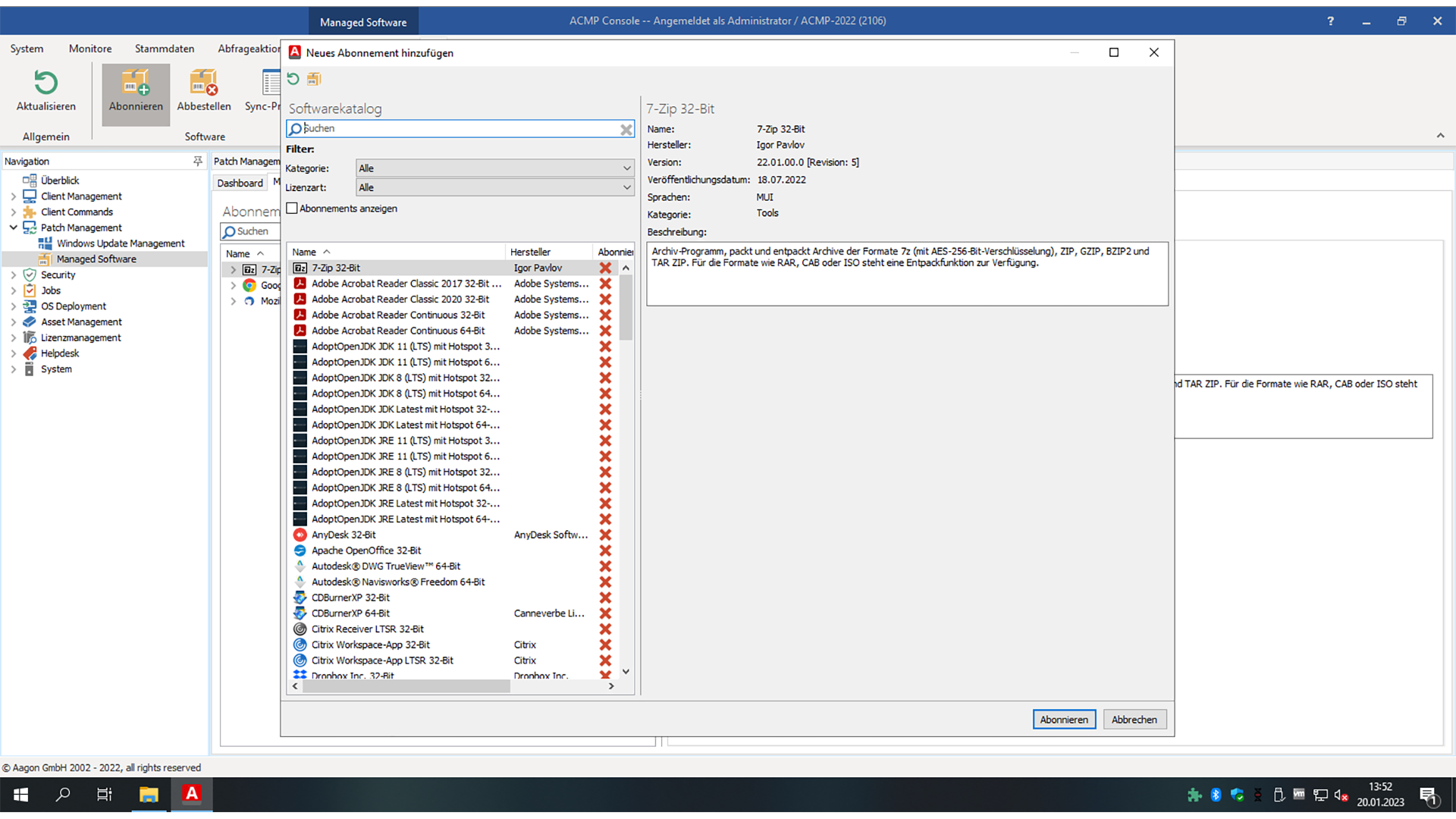
acmp Managed Software now makes it possible to carry out these updates using pre-packaged software bundles for a large number of different third-party software. A huge selection of different standard software packages is available to you.
The most important features at a glance

Various test and release rings

Quality-assured software packaging

Maximum flexibility through individual adaptability

Clear clean-up and parameter settings
Huge selection of different standard software packages
acmp Managed Software now makes it possible to carry out these updates using pre-packaged software bundles for a large number of different third-party software. A huge selection of different standard software packages is available to you. All security-relevant updates are fully tested and provided with quality assurance.
Plannable distribution of software packages
Various test and release rings allow you to plan the distribution of software packages. This allows you to maintain an overview and ensure that the newly installed package really does integrate smoothly into your IT environment without any nasty surprises.
Integrated clean-up automation
Integrated clean-up automation makes it easier for you to manage your software packages and determines when an obsolete package should be deleted.
Special bonus
Each of the software packages can be modified as required via its individual parameters and thus adapted to your needs. This gives you maximum flexibility and maximum security for your IT environment, as the ready-made packages are subject to constant monitoring and are continuously updated and expanded.
Product insight
References
What our customers say



acmp Editions
Our product portfolio provides a structured overview of our versatile UEM solution acmp, consisting of different editions and supplementary add-ons. This allows us to flexibly cover your individual requirements and provide scalable solutions for various application scenarios.
Starter
Die Starter Edition bildet den idealen Einstieg in das Unified Endpoint Management.
Beinhaltet folgende Funktionen:
- Inventarisierung und Reporting
- Konnektivität und Sicherheit nativ integriert
- Betriebskontinuität – durch steuerbare Systemverfügbarkeit
- Granulare Test- & Freigabeprozesse
- Zentrales Microsoft & Windows Update Management
- Drittanbieter Kataloge für Treiber
Advanced
Die Advanced Edition richtet sich an Unternehmen, die ihr Unified Endpoint Management über die reine Inventarisierung hinaus automatisieren und standardisieren möchten.
Starter Edition plus:
- Zentrale Softwarepaketierung und Verteilung
- Automatisierungsplattform für den IT-Alltag
- Unix-Skriptverwaltung zur breiten Systemabdeckung
Professional
Die Professional Edition ermöglicht darüber hinaus volle Kontrolle über Anwendungen und den gesamten Software-Lifecycle – für mehr Sicherheit, Transparenz und Compliance.
Advanced Edition plus:
- Automatisches 3rd Party Patchmanagement
- Zuverlässig geprüfte Installationsressourcen
- IT-Ressourcen optimierende Bereitstellung
Expert
Expert Edition ermöglicht vollständiges Unified Endpoint Lifecycle Management in einer
zentralen Plattform und richtet sich an Organisationen mit komplexen IT-Landschaften.
Professional Edition plus:
- Zeiteffizientes OS-Deployment
- Granular und reproduzierbare Betriebssystemeinrichtung
- Betriebssystem unabhängiges Lifecyclemanagement
Asset Management Add-on
- Vollständige Übersicht über Hardware-Assets
- Unterstützung bei Budgetplanung
- Lizenzierung nur für verwaltete Endpunkte
- Verknüpfung technischer Inventardaten mit kaufmännischen Informationen
- Einheitliche Datenbasis für Reporting und Audits
- Nachvollziehbarkeit von Gerätezuordnungen
- App inkl. QR Code Scanner für mobilen Zugriff
-
Überwachung und Durchsetzung von BitLocker-Verschlüsselung
-
Verwaltung und Standardisierung der Microsoft Defender Antivirus-Konfiguration
- Identifikation und Behebung von Schwachstellen
- Reduzierung von Angriffsflächen durch automatisierte Sicherheitsrichtlinien
- Erhöhte Compliance bei regulatorischen Anforderungen
- Integration in Automatisierungsprozesse für effizientere Sicherheitsmaßnahmen
-
Transparenz über Lizenznutzung und-verteilung
-
Reduzierung von Compliance-Risiken durch genaue Lizenzkontrolle
-
Optimierung von Lizenzkosten durch gezielte Analysen
-
Präzise Lizenzmodelle durch Verknüpfung von Inventardaten mit DNA
-
Automatisierte Bereinigung von Über-oder Unterlizenzierungen
-
Unterstützung bei strategischer Lizenzplanung und Audit-Vorbereitung
-
Zentrale Anlaufstelle für Anwenderanfragen und Störungen
-
Schnellere Bearbeitung von Incidents und Requests
-
Transparenz über Tickets, Bearbeitungsstände und Verantwortlichkeiten
-
Benutzer-Self-Service für Standardanfragen
-
Automatisierte Lösungen durch Integration mit Desktop Automation
-
Dokumentation und Nachvollziehbarkeit aller IT-Vorgänge
-
Zentrale Sicht auf On-Prem-und Cloud-Clients
-
Einheitliche Betriebsprozesse über alle Geräte hinweg
-
Vermeidung von Tool-Silos durch Integration in acmp
-
Ergänzung von Intune um detaillierte Inventar-und Automatisierungsfunktionen
-
Einheitliches Reporting über alle Endgeräte
-
Effiziente Verwaltung hybrider von UEM-Mehrwerten
Would you like to find out how we can improve your everyday IT life with our solution? Then register for the appropriate events and get to know us better.
FAQ
Can my clients be automatically kept up to date?
Yes, with acmp Managed Software, clients can be supplied with the latest versions of software in a targeted manner.
Can packages also be distributed manually?
Yes, the acmp push function can be used to distribute jobs manually and also with a timing.
Can distributed packages also be uninstalled again?
Yes, all packages can also be uninstalled again.
Can a rollback be performed in an emergency?
Yes, through a combination of uninstallation and direct subsequent installation.
What are distribution rings?
The distribution rings or test rings can be used to test the packages in up to three stages on a small number of computers before they are then automatically distributed to all computers if desired.
Noch Fragen? Wir helfen Ihnen gerne weiter oder vereinbaren Sie direkt einen Termin unter:
+49 2921 789 200 oder sales@aagon.com