
Unified endpoint management for the healthcare sector
Automate IT processes, meet the highest security and compliance standards and retain full control over the IT infrastructure.
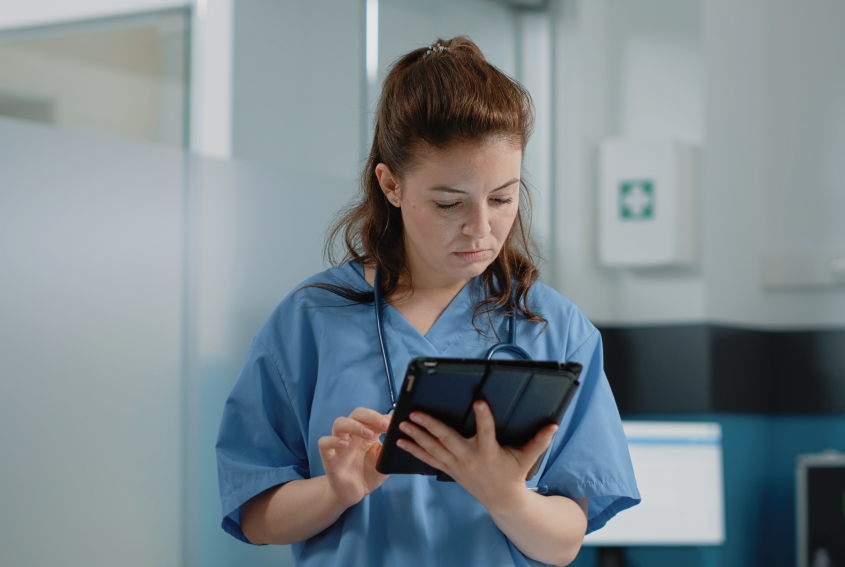
The challenges of digitalization
These challenges can be overcome with reliable and powerful unified endpoint management for the healthcare sector - for greater efficiency and security
Security & Compliance
Legal requirements such as ISO, PDSG and NIS-2 demand the highest security standards. Complete documentation, secure patch management and strict access controls are essential to ensure data protection and cybersecurity. Automated security solutions make it easier to implement these requirements - even in the 24/7 operation of clinics and care facilities.
Scarcity of resources & cost pressure
IT departments in the healthcare sector are faced with the challenge of efficiently managing complex IT infrastructures despite limited budgets and staff shortages. Increasing cost pressure is forcing hospitals to optimize processes in order to remain economical and fit for the future. Automation can help to improve processes and deploy resources in a more targeted manner. The Hospital Future Act (KHZG) provides financial support for digitization with a development fund of 4.3 billion euros. So-called must-have applications must be implemented by December 31, 2025 as part of the KHZG.
Inefficient IT infrastructure
Manual processes and a lack of standardization complicate IT administration in hospitals and social institutions. Automated software distribution, intelligent license management and optimized system integration significantly reduce the administrative effort and ensure greater security and stability.
Interoperability & scalability
IT in clinics, care facilities and social services must be flexible, secure and controllable across all locations. A central management platform enables the integration of new technologies, simplifies device management and creates a future-proof, scalable IT infrastructure.
The most important advantages of acmp for the healthcare sector
acmp streamlines your processes, saves time and meets all compliance requirements. The modular Unified Endpoint Management solution from aagon is optimally tailored to the requirements of social services, hospitals and care facilities and supports you on numerous levels:

Comprehensive functions in one solution

Support & individual customization

Digital asset capture & integration

Uncomplicated scaling & management
Building blocks for success: The most popular acmp modules for the healthcare sector
The acmp Suite offers suitable modules for all important areas of your Unified Endpoint Management:
Increased efficiency through automated IT processes
acmp automates recurring tasks such as software distribution, device configuration and user administration. This reduces manual administrative work, optimizes processes and relieves the burden on IT teams in hospitals, care facilities and health authorities.
You can find more information here: Automation of routine tasks
Secure and efficient Windows updates in medical facilities
Regular Windows updates are essential for IT security in the healthcare sector. acmp enables fully automated and secure distribution of updates and selected drivers from third-party catalogs - without the use of WSUS. This saves bandwidth, minimizes downtime and ensures a continuously protected IT infrastructure in clinics and practices.
Further information can be found here: Windows Update Management
Central software management for secure IT in the healthcare sector
Medical facilities use numerous specialized programs - from practice software to imaging software. acmp ensures that all applications are centrally managed, updated and licensed. This guarantees smooth operation, protects sensitive patient data and minimizes security risks due to outdated software versions.
Further information can be found here: Patch Management
Fast and standardized operating system installation
In hospitals and care facilities, many PCs and medical devices need to be equipped with identical operating systems. acmp automates this process and ensures that all systems are installed in a standardized way - including UEFI and secure boot support. This keeps IT secure, efficient and always up to date.
Further information can be found here: Operating system provisioning
Compliance and cost transparency for healthcare IT
Clinics, laboratories and medical practices have to manage numerous software licenses while adhering to strict data protection and compliance requirements. acmp records all license types, identifies dependencies and prevents over- or under-licensing. Automated reports make it easier to prove software compliance and help to avoid unnecessary costs.
Further information can be found here: License management
Effective protection against cyberattacks in the healthcare sector
IT systems in the healthcare sector are a popular target for cyber attacks. acmp Defender Management enables central control of Microsoft Defender Antivirus, optimizes virus scans and reports threats. With comprehensive reports, IT departments maintain control over the security of all networked devices at all times - from administrative PCs to medical technology systems.
Further information can be found here: Defender Management
Case Studies
Our customers are already benefiting from the successful implementation of acmp solutions. Read here how social services, hospitals and care facilities work more efficiently and safely with acmp.
task that I could not query or implement via the acmp Suite.
or implement.
Frequently asked questions
In our FAQ section you will find answers to the most important questions about IT optimization for social services, hospitals and care facilities.
Why is centralized Unified Endpoint Management particularly important in healthcare and social services?
Hospitals, care homes and social institutions manage a wide range of IT devices - from ward PCs and mobile devices in the care service to networked medical devices. At the same time, strict data protection and security requirements apply. Centralized Unified Endpoint Management ensures automated software distribution, secure patch management and uniform control over all end devices, thus guaranteeing the necessary security and efficiency.
How does acmp support social services, hospitals and care facilities in complying with legal regulations (ISO, PDSG, NIS-2)?
Healthcare facilities must meet high data protection and security requirements. The Patient Data Protection Act (PDSG), ISO 27001 certification and the EU NIS-2 directive demand a high level of IT security. acmp facilitates the implementation of these requirements with automated vulnerability management, automated responses and seamless documentation - essential for audits and compliance checks.
What advantages does automation offer IT departments in the healthcare sector?
In hospitals and care facilities, IT systems run around the clock and must function stably and securely. Automated processes reduce maintenance costs by centrally managing software updates, operating system installations and security patches. This allows IT teams to minimize downtime and focus on critical tasks.
How does acmp help to overcome the skills shortage in the IT sector?
Many social services and care facilities have small IT teams that have to manage numerous locations and devices. acmp automates recurring tasks such as software distribution or license management, reducing the workload of IT staff. In addition, the intuitive operation enables quick training, even for less specialized IT staff.
Can acmp be used in care facilities with multiple locations?
Yes, acmp is also suitable for facilities with multiple locations, as it enables centralized IT management. For example, care facilities or hospital groups can manage software updates and security guidelines uniformly across all facilities - regardless of their size or infrastructure.
What security measures does acmp offer for hospitals and care facilities?
Hospitals and care facilities are increasingly the target of cyber attacks. acmp helps to secure IT systems with vulnerability management, automated Windows updates and software distribution.
How long does it take to implement acmp in healthcare facilities?
The duration of the implementation depends on the size of the organization and the existing IT systems. Smaller facilities can introduce acmp within a few days, while large hospital groups with complex IT structures require several weeks for a complete implementation. However, thanks to preconfigured modules, the rollout can take place without interrupting ongoing operations.
What training courses are available for IT teams in the healthcare sector?
aagon offers practical introductory workshops, administrator training and webinars on current security topics. Large institutions can also book customized training concepts that are tailored to their specific requirements.
What advantages does acmp offer over conventional IT management tools?
Thanks to its optimized focus on the requirements of medium-sized IT departments, acmp is also ideal for use in the healthcare sector. A quick and uncomplicated rollout is therefore possible without any problems. It combines powerful automation, high security standards and flexible scalability. This means that both small care facilities and large hospital groups can manage their IT efficiently and meet legal requirements more easily.